
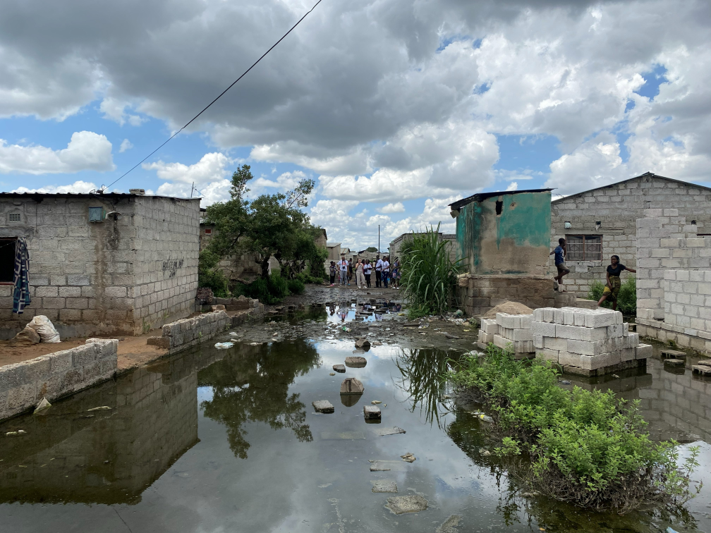
A new paper “Inclusive climate adaptation through intersectional co-production: gender- and disability-disaggregated evidence from southern Africa” has just been published in the journal Climate and Development. The paper was authored by Katharine Vincent, Willem Colenbrander, Gilda Monjane, Marita Monjane Saraiva, Miriam Murambadoro, Liz Venable, Declan Conway, Denyse S. Dookie, Kate Elizabeth Gannon, Will Ingram and Katarzyna Mikołajczak, using data from the Weather and Climate Information Services, Early Warnings for Southern Africa (WISER-EWSA) and Climate Adaptation and Resilience (CLARE) Behavioural Adaptation for Water Security and Inclusion (BASIN) projects.
Inclusive climate adaptation is widely promoted but remains under-evidenced in practice. The paper examines an intersectional co-production process in urban and peri-urban southern Africa aimed at improving weather and climate information services, with particular attention to women and persons with disabilities. The study combines surveys, focus groups and interviews in Kanyama, Zambia, and Boane, Mozambique. Surveys of 100 community members in each location at baseline in 2023 were repeated at endline in 2025 (100 in Kanyama and 98 in Boane), alongside four focus group discussions and interviews with community observers (24 in Kanyama and 7 in Boane).
The process included inclusive engagement and tailored communication materials to improve the usability of weather information. Around half of the participants in the co-production process were women and around one eighth had disabilities. Community observers reported enhanced confidence, empowerment and perceived social status. The process led to improved trust in, access to, attention to, and action on weather information across all groups, but the gains were uneven. Women faced greater barriers to acting on information, while accessibility remained the main barrier for persons with disabilities.
The paper shows that intersectional co-production can advance representational and procedural justice and improve distributional outcomes. However, inclusion in process alone is insufficient to overcome structural inequality. Because the samples were too small for a combined analysis, outcomes are analysed by gender and disability separately, not in combination. The paper calls for climate services design and evaluation through an explicitly intersectional lens, with greater attention to disability inclusion, differentiated barriers, and justice-oriented measures of success embedded from the outset.