
A new paper “Opportunities for Increasing Resilience to Changing Severe Weather in Southern Africa: “Early Action and Enhanced Adaptive Capacity for All”” has just been published in the journal Bulletin of the American Meteorological Society. The paper was authored by Elizabeth J. Kendon, Luis Artur, Francois Engelbrecht, Dewald Van Niekerk, Carlos Ayala, Alexander J. Baker, Ailish Craig, Catalina Jaime, Renate Meyer, Francisco Orozco-Meléndez, Elisabeth Stephens, Charles Vanya, Katharine Vincent, Coleen Vogel, Gabin Dahad, Sedera Anjarasoa Randrianirina, Minohery Mahatoky, Ny Ony Patricia Andriamahenintsoa and Tanjoniaina Livasoa Carenne Randrianjafy.
The paper examines why early warning systems (EWS) in southern Africa do not always lead to action, and what would make them effective as climate change brings severe weather beyond anything experienced in the past. It draws on community-based fieldwork and stakeholder engagement from several research projects in the region, including REPRESA, WISER Early Warnings for Southern Africa (EWSA) and ACACIA, and focuses on tropical cyclones, flooding and drought.
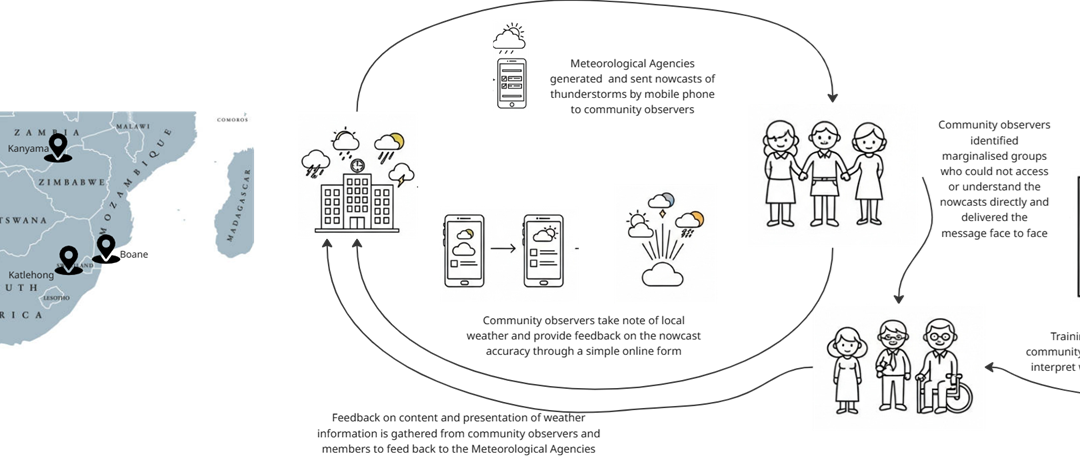
The paper finds that most people receive warnings, but many do not act on them. Household surveys in Madagascar, Malawi and Mozambique show that 90%, 80% and 77% of people respectively receive warnings of approaching tropical cyclones, yet less than half evacuate after receiving an alert. Research under WISER-EWSA in Zambia found that among those who do not usually, or never, act on warnings, 70% were female and 40% had a disability. Key barriers include communication gaps, a lack of trust, involuntary immobility, the limited inclusion of vulnerable groups, a lack of integration of climate change considerations into EWS design, and limited coordination across governance levels.
To address these barriers, the paper outlines six priority areas: understanding the risks of unprecedented events; stress testing of EWS; equipping national hydrometeorological services; community participation toward vulnerability-focused EWS; integrating local and scientific knowledge; and strengthening coordination across agencies. These actions support a shift from providing warnings to enabling action. The paper also recognises that there are limits to what EWS can achieve, and that long-term adaptation investments and strategies, harmonised with EWS, are needed in the face of unprecedented events.